Kiowa
News of the WorldKiowa is a people whose presence in the novel cannot be reduced to the force that captured Johanna Leonberger: they are also her family and community, the source of the language and practices she retains, and a people whose lives continue through stories. Their encounters with Jefferson Kyle Kidd’s party expose the limits of his knowledge, while Johanna’s lasting attachment to Kiowa life unsettles the idea that returning a child to her birth relatives restores what captivity has changed.
Identity and Representation
The novel presents Kiowa life through concrete scenes rather than a broad account of political or social organization. A band travels with horses, children, and belongings carried on travois; its camp can be driven from place to place by flood. The narrative associates this mobility with a life responsive to water, weather, and circumstance, in contrast to the fixed houses and accumulated possessions of the white communities Kidd encounters. The contrast is not only material: it turns on different understandings of what makes a life secure and what a person ought to know how to do without.
That representation is partly shaped by Kidd’s perspective. He recognizes that Johanna considers the Kiowa her people and their gods hers, but he cannot fully comprehend the transformation that has made this true for her. The book therefore shows Kiowa people acting and speaking, while also marking the distance between their experience and the older white narrator’s understanding. Their culture is not presented as something Johanna can simply shed when she is delivered to German relatives.
Captivity, Kinship, and Rescue
The story places Johanna’s captivity within a wider pattern of capture and attempted return. Britt Johnson has rescued at least four captives from the Comanche, Kiowa, and Cheyenne, and his own wife and two children were taken six years earlier, in 1864, before he went out and brought them back. His experience makes him a rescuer with unusual knowledge of the danger and difficulty involved. Yet he refuses to take Johanna to her parents for the offered fifty dollars in gold, explaining that the journey would mean three weeks south and three weeks back, with no haulage for the return trip. His refusal is practical, but it also reveals that rescue depends on people and circumstances, not on a simple transaction.
The narrative does not treat captivity as a harmless change of household. Kidd reflects that children captured after violence and the killing of their parents may carry that experience invisibly for the rest of their lives. Johanna’s later estrangement from her birth culture is thus set beside the violence that preceded it. The book does not make that history disappear by calling her return a reunion; the competing claims of birth family, Kiowa upbringing, and legal guardianship remain unresolved in her experience.
Encounters and Agency
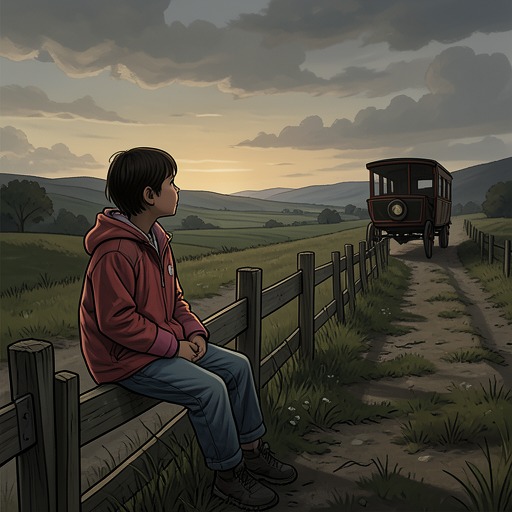
At the flooded Red River, Kidd sees Johanna on a rock across from a Kiowa party whose camp may have been displaced by the rising water. She calls to them in Kiowa, but the flood is too loud and the distance too great for them to hear. The band appears with children, horses, and tipi poles, its people looking across at the girl as she calls for her parents, siblings, and the life of the Plains. The scene gives the separation a physical form: water divides people who recognize one another, while neither Kidd’s presence nor the prospect of delivery to German relatives can make Johanna’s longing less real.
Johanna is not merely a passive object of that conflict. During a gunfight with Caddo attackers, she moves among the red sandstone carrying a stove-lid lifter, helps dislodge a slab of rock, and chants in Kiowa after the attackers flee. Her actions and words draw on a knowledge that Kidd cannot share, and the episode makes visible how much of her capability belongs to the life she has lived among the Kiowa. Later, at a stream, four young Kiowa men emerge from the branches of a live oak, carrying bows and quivers. Kidd raises his revolver and fears Johanna may call out to them; she instead puts a hand on his arm and shakes her head once. The visitors slip away quietly. The encounter ends not in a battle but in a choice made by Johanna, whose allegiance cannot be inferred simply from her origins or from the fact that she has been taken away.
Cultural Ethic and Lasting Identity
The novel associates Kiowa identity with endurance and the ability to make do. Johanna never learns to value the possessions white people prize in the same way; the narrative describes the Kiowa ideal as pride in going without water, food, or shelter when necessary. Courage, rather than fashionable clothing or a bank account, is presented as the baseline of life. These observations are conveyed through Kidd’s growing recognition that his own measures of value are changing in Johanna’s company. He does not become an authority on Kiowa life, but he increasingly sees the insufficiency of the values he had taken for granted.
The difference appears in ordinary gestures as well as dramatic danger. Johanna stares directly when something interests her, asks questions that can embarrass white listeners, and regards animals as food rather than pets. She takes a long time to understand coins as legal tender rather than ammunition. Such details show cultural difference operating in daily perception, not as a costume that can be removed when she enters a European household. When relatives try to teach her their ways, she sits on the floor and sings quietly in Kiowa; their assumptions that she will be glad to return do not match the person before them.
Return and Continuance
After four years among the Kiowa, Johanna has forgotten her birth language, parents, people, religion, and alphabet, and her return restores none of them. She remains Kiowa at heart, despite efforts to make her live as a white girl. The novel leaves the tension intact: she can share a home and a future with Jefferson Kyle Kidd while retaining an identity that her German relatives cannot recover or fully recognize. Her life demonstrates the enduring force of the relationships and cultural knowledge formed during captivity, without presenting that formation as a simple or painless substitute for the family she lost.
The Kiowa also endure in the novel’s closing account through memory and retelling. Their warriors’ bones, the narrative says, do not lie in the earth but in stories of bravery and daring; those stories include Britt Johnson’s death and Three Spotted’s blue-eyed girl, Johanna. The image gives the people a continuing presence beyond the scenes in which outsiders encounter or displace them. Their story is not only one of a child removed from them: it is also a story they keep, tell, and carry forward.